Wednesday, October 24, 2012

New Year, New Class, New Club!

We're back in action at BHSEC and making the most of the waning sunlight. This semester our Food Politics and Systems classes are taking a new format; we are cycling through the 10th grade advisories with workshops in cooking, gardening and food politics. We are happy to have the opportunity to reach so many students and give them the tools to take responsibility for their food choices at home, at school and in their community.

Here is what is in store for the classes:

Class 1: Basic Gardening-  This class will focus on growing skills for seed to harvest with work in the BHSEC garden and indoor seed starting during the winter months.

Class 2: Basic Cooking Skills-  Taught in the BHSEC cafeteria kitchen the focus of this class will be building culinary skills with discussion focused on food access and nutrition.

Class 3: Food Politics- This class will focus on the politics that determine national and local food policy with a critical discussion and analysis of the Farm Bill.
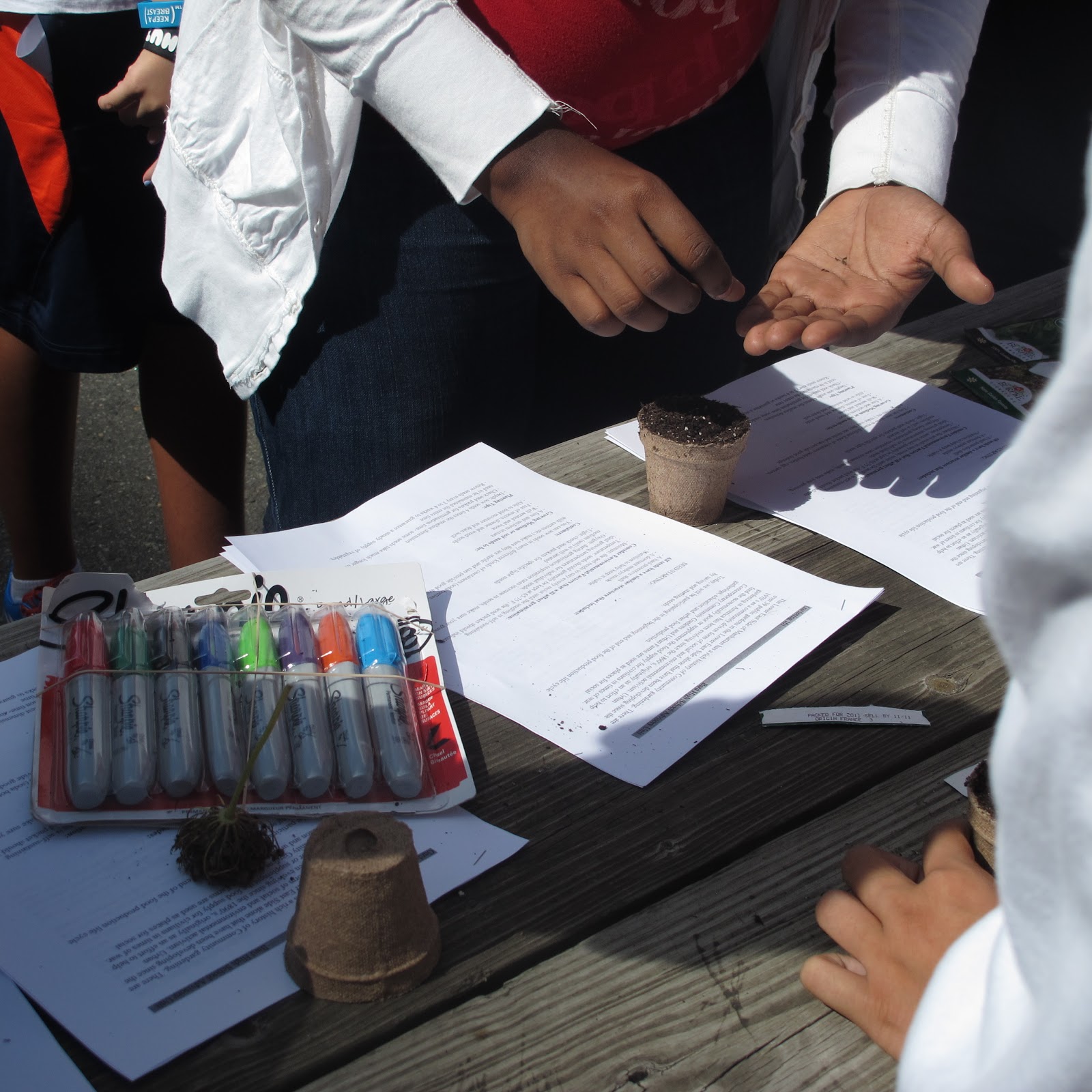
What to do with these seeds?

Ah! Plant them, water them, love them.

Collecting seeds to save
The second exciting development of the year is the formation of our Garden Club or as Tess likes to call it, "ladies garden hour" (yes, its all girls for now). We have so many exciting plans for the year including field trips, garden design classes and cooking lessons. We can't wait to cook with our just-picked edibles in the spring!

Sign up for garden club!

Wielding a rake in a skirt, watch out.

Taking care of our tree pits- each member is responsible for two.

We are still harvesting Basil and Peppers!
Its the coolest club in town.

Sunday, May 27, 2012

The IFAP and Our Relation to It - Alex Fenichell

I don’t think IFAP is sustainable, but I am having a hard time explaining why. In other words, if I had to convince all those involved in IFAP to stop what they’re doing, I don’t think I could do it. Except for an appeal to the morality and humanity and empathy of IFAPers, I know of no effective methods. From the movie we watched, I am most struck by a few things. First, the animal waste confinement farms produce and how poorly managed that waste is. Second, I am struck by the density and poor living-conditions of animals in factory farms [huge space + high density=woah]. Third, I am struck by the corporation-dictators who determine how smaller serf-like farmers work and thus live. Fourth, I am struck by the manipulative power of corporate “bucolic dairy farm” propaganda. Finally, I am struck by how attractive the pasture system and other alternative animal food production methods appear in the film. If IFAP is unsustainable, then I think an alternative for meat and dairy would look like a nation-wide local-as-possible pasture system, with a larger percentage of the population working as farmers.

As consumers: Buying and eating are voting; they are political acts. To avoid contributing to the faults of IFAP, if we eat meat and dairy in the first place, we can eat less of it. If we can afford to, we can buy meat and dairy sourced from independent farms. We should avoid contact and involvement with IFAP as much as possible as consumers, but as citizens we should involve with it by trying to improve it or replace it with more sustainable alternatives.

Alex's post on Pollinators (and compost).


On our thursday class we learned about pollination. On our tuesday class we learned a) about the odorous and noxious problems of putting too much chicken poop into compost, and b) what it must have smelt/felt like to be a feudal dung-shovelling serf! As profoundly humbling as learning about pollinators was -- humbling because although humans can be pollinators, MOST pollinators are insects, non-human animals, winds, and rains, so that we can't give ourselves credit for everything that benefits us and we should be humbled and grateful -- I found the compost experience more valuable and edifying. I will NEVER put that much of an odorous substance into compost ever again. On a more serious note, well-done compost is very helpful for us as humans and environmentally helpful a smart use of waste. However, as we learned on Tuesday, well-done compost demands a careful BALANCE of components that simply was not there with that demon-stuff we shoveled. I actually have no idea if the overly-nitrogenous compost will work well as a fertilizer, but as Tess said "Compost is not supposed to smell like that!" I suspect that a good compost smells better than that fowl-feces-fiesta we worked with. I propose that we discuss what makes a good compost in class. Now I will stop the compost-bashing (I am also in no way blaming the awesome people at the park we go to--thank you for working with us guys!).

A note on the pollinators: I am always surprised every Spring by how few pollinators I see compared to how many flowers I see. What a beautiful, subtle, and healthily transformative process for flowers to bloom in Spring all with the 'help' (unwitting or unconscious) of pollinators! I can easily imagine how people could think of a god or divine force causing the Springtime bloom. Also, it is amazing the sort of co-evolution that has happened between pollinators and plants: I recommend looking up videos of this amazing subject! Thats all folks, :)

Wednesday, May 23, 2012

Food Animal Production


          Industrial Food Animal Production (IFAP) is basically a method of farming that is supposed to help "improve" the production of farming. However, it is actually a very unethical method because this system involves raising thousands of the same time of animal, in a very packed environment. The animals are not treated too well and are also over fed and given growth hormones. In the film we watched, there was a woman who was very against this system. Instead of completely excluding meat or dairy in her diet, she decided to start her own farm. She claimed that people will never stop eating animals, so what needs to change is the production process of animals. IFAP is obviously not the method of farming we all want to have, but asking people to step away from such a technologically advanced and highly profitable system is very unrealistic. Hopefully, people will slowly start changing their ways and will revert to the safer and simpler way of farming. This will not only help our own environment and health, but possibly other countries as well because our behaviors will have an influence on theirs. What we can do as consumers is make sure we know exactly where our food is coming from. Making sure to buy food from small farms rather than buying food that came from a big factory.

Tuesday, May 22, 2012

Food Animal Production


Food Animal Production
Food Systems and Politics

Industrial food animal production (IFAP) is no longer sustainable or good for the environment, agriculture or human safety. The movie suggests that in order to attain a sustainable food animal production process, society must come up with one that is both ecological and preserves and does not limit biodiversity. A dream process would be that all farms move to pasture base production instead of factory base. Although many would call switching non-realistic, this common misconception is famous because industrial food animal production has been perceived as more productive and an easier way to raise animals in a shorter amount of time. The movie provided an inspirational example about one man who did make the shift over to the good side when he switched from factory base to pasture base production. He remarked that not only did pasture base farming hardly require more work than his pervious system, factory base, but that he also felt satisfied that he was doing something good for the environment, agriculture business and human safety (all the things that industrial production cannot supply). People are caught in this rhythm of the factory in the new industrial system and they don’t know how to get out because it is hard, but this switch helped prove the stereotype wrong, which will hopefully persuade others to follow in his footsteps. Essentially, the movie implies that we should go back in time to the 1700s where the industrial period in America had not taken place and farming and food animal production was carried out without all the modern technological agricultural items available. One of the risks of this factory-based system is that it is being spread to other countries around the world and being adopted as the primary process. This is why it is so important to stop it now. It is important not to contribute to the harmful animal production practices, which can be ensured by not supporting them as consumers. We should not buy from any farms that are not pasture base and use our power to support a process in which is safe for human health, agriculture and the environment.

Jenna M

Tuesday, April 24, 2012

Beet Cake and Lip Balm: A Delicious Combination


This past week, Food Systems and Politics class was action-packed and we had a special guest, Isa Brito, an herbalist, who helped lead and instruct the two classes. We took a break from the way we usually have class, after we handed in our assignments on gardening techniques, companion planting and square foot gardening.
On Tuesday, Isa taught us how to make our very own lip balm. Making the lip balm was a quick and easy procedure allowing us to recreate the balms independently at home; it was a recipe made in a few simple steps using simple ingredients. First, we measured about five ounces of squares of beeswax (later to be melted) on the electric scale. Our main ingredient, avocado oil, was added to the measuring cup (about ten ounces) and then we put our beeswax in with the oil to be melted into one mixture. Keep in mind, it is important never to boil the ingredients and to only heat them so that they do not burn. We then selected one of the four special essential oils, rose geranium, spruce, peppermint, and lemongrass, to add to our own personalized scents to the lip balm (by putting a few drops, around four to six, in each tube). After the ingredients became one consistency (mostly yellow, with a small hint of green), Isa poured it into the lip balm tubes (which we designed our own labels for). They hardened within minutes and she did another round of pouring to top off the hole on the top. This creation was an all-natural and relatively easy procedure to follow which only took about an hour or so with ingredients easily accessible to purchase. At the end of the day, we all walked out with souvenirs, our own lip balms, we could share with our friends and family (my mom loved hers!).


On Thursday, we were back in the kitchen, putting on our disposable aprons and hairnets, with Isa showing us how to cook the delicious and unusual beet cake. It was great to get back in the kitchen again and it was interesting because hardly anyone ever made this creation before. We all pitched in and did different jobs to make the long cooking process much shorter than it would be if we only had two hands (instead of twenty). It is also interesting to know that very similar ingredients and procedure can be applied to produce a similar cake such as a banana cake (which she recommended). We made two heart shape cakes with poppy seeds to form a crust, which were sprinkled on the pan. Since we had so much “batter” left over, we decided to make cupcakes, which we added cocoa powder to! We topped the cake off with a rich, sugary cream cheese icing (which I thought was the best part). 

These are some pictures of our beautiful beet cake creation. It makes me want to eat it all over again!